Sage pack rod
The Dog StarsThe Sage pack rod is both a practical fishing tool and one of Hig’s most enduring links to his father, to the discipline of fishing, and to a life organized around care rather than defense. Small enough to take into the mountains, it gives shape to a repeated ritual that persists through personal loss and social collapse. In the changed world, assembling it still makes room for patience, attention, and a form of meaning that cannot be reduced to survival.
Provenance and Construction
Hig has owned the Sage pack rod since high school. His father gave it to him for his sixteenth birthday, shortly after Hig came to live with him. The rod is a four-piece, number-four model; its sections travel wrapped in flannel, ready to be fitted together at a stream. Its portability makes it suited to the mountain trips Hig continues to take even after life at the airport has narrowed around vigilance and the need to carry a rifle.
The gift’s history is marked by an absence: Hig’s father died of pancreatic cancer the following year, before he could show Hig how to use the rod. Hig taught himself and also learned from Uncle Pete. Fishing therefore became an inherited practice without direct instruction from the person who gave him its central implement. Hig tried to fish as he imagined his father might have, with the intensity of a son whose father had little time to guide him. The rod carries that aspiration in a tangible form, though the technique and ritual Hig builds around it are his own.
The rod came with an Orvis reel from his father. Hig slides its reel foot into the aluminum slot atop the cork handle and secures it by tightening a nut around the rod seat. The nut’s deep diamond pattern gives his thumb and forefinger a firm grip; turned down, it locks the reel in place. These concrete fittings matter because the rod’s use begins not with a catch but with a practiced sequence of assembly, alignment, and fastening.
Use and Ritual
Hig sights along the rod’s guides and twists the shining metal loops until they line up true, then strings the rod. He has repeated these motions hundreds, perhaps thousands, of times. Their familiarity makes the preparation almost automatic, but he understands it as more than routine: fishing calls forth his attention, carefulness, willingness to risk, love, and patience. While other parts of his life have failed to work smoothly, he has kept the reel cleaned and oiled. Maintenance becomes one small, continuing act of order.
The ritual is inseparable from its setting. Hig carries the rod into the mountains, puts down his pack, and breathes beside running water before stepping among the creek stones. He no longer wears waders; he likes the cold water against his legs. As the stones become wet, their greens, russets, and blues emerge, and Hig feels himself come alive with them. The rod does not simply enable fishing: its familiar preparation brings him into attentive contact with the stream and the living landscape.
On another trip, Hig takes the rod case from the sled so Jasper knows he is officially off duty. Hig assembles and strings the rod while Jasper lies on a flat, sunlit rock and watches. The scene marks a temporary change in their shared work: the dog’s tracking role gives way to rest beside Hig’s fishing. Hig removes his boots and pants, changes into sticky-soled sneakers, and returns to a practice adapted to the precarious present. He has taken five replacement pairs from a store parking lot, estimating that each set might last about three years, though the years ahead resist any confident calculation. He concentrates instead on tying on fresh tippet and a tufted fly, making the next cast, and hoping the day lasts until nightfall and dinner. The first fish is meant for Jasper.
A Practice Through Loss
Fishing accompanies Hig through successive losses and upheavals. After losing his high-school girlfriend, he fishes; when frustration and despair lead him to stop writing, he fishes again. He fishes when he meets Melissa, at a time when he scarcely dares hope that he has found a love beyond anything he has known. The rod’s recurrence across these different circumstances gives it a steadiness that the events themselves do not possess: it remains the means by which Hig returns to a familiar, deliberate practice.
That continuity holds even as the living world changes. When disease strikes the trout, Hig continues fishing. When the flu takes Melissa in an Elks Hall converted into a crowded hospital less than five hundred yards from their home, he fishes. He is not allowed to bury her; she is incinerated with the others. Amid dwindling supplies, longer gas lines, and riots, he fishes on, turning to nymph fishing for carp partly to escape and follow a creek whose bends and moods he knows intimately. The practice does not undo bereavement or restore what has disappeared. It gives grief a repeated action and a route through a landscape Hig has learned by attending to it.
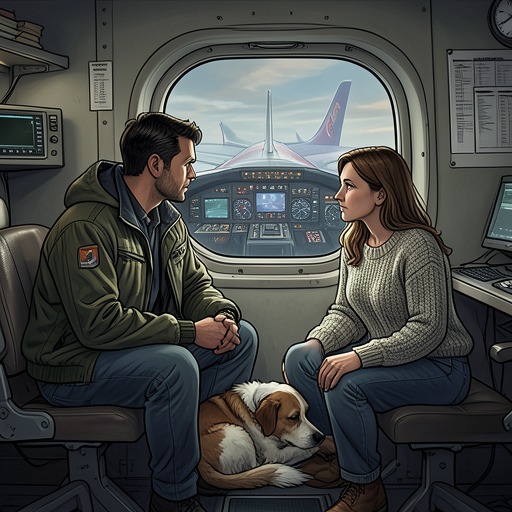
Years later, Hig still brings the rod into the mountains from the airport. He sets down his pack and assembles it while Jasper settles nearby, able to watch. The contrast between the armed, defensive life at the airport and the close attention of fishing makes the rod an emblem of a different mode of being, but not an escape from the world’s dangers: it is carried within that world, among the same trips and precautions.
Meaning and Absence
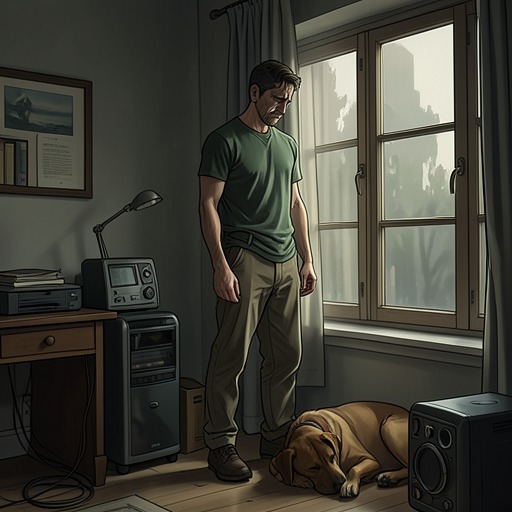
When Hig goes walking without the rod, he remembers that he has not fished in over a year, not even the previous summer. He wishes he had the rod and Jasper, only a day pack, and no gun; instead, he has none of them. Lost in the memory, he reaches the first trees of the mountain front before realizing he is alone. His sudden fear centers on Jasper’s absence, and he turns back toward the airport. The rod is not the cause of that fear, but its remembered pairing with Jasper and the fishing routine clarifies how much of Hig’s former pattern of companionship is missing from the solitary walk.
The Sage pack rod thus gathers several kinds of continuity without making them interchangeable. It preserves the father’s gift, even though Hig’s father could not teach him to use it; it supports a self-made discipline Hig returns to after losses; and, in the mountains, it helps organize quiet time shared with Jasper. Its lasting significance lies in that precise, repeated use: the rod must be assembled, tended, and carried to water, where Hig can offer his attention to something still living.